One-Page Website Service: Essential Guide to Costly Agency Mistakes
On this page
ContentsTL;DR: Our turnkey one-page website service replaces sluggish legacy site builds with high-performance architecture deployed in 3–7 days for 5,000,000 to 10,000,000 VND. By combining custom frontend execution with clear narrative funnels, we eliminate bloated vendor retainers, technical maintenance drag, and ad budget waste while giving growing businesses total ownership of their baseline digital asset.
- Why Is the Traditional Web Development Model Broken for Lean Teams?
- What Financial Baseline Governs Status Quo Builds Versus a Focused Page?
- How Does Our 5-Phase Engineering Framework Guarantee Delivery?
- When Is a Single-Page Site the Right Strategic Investment?
- When your operational requirements call for complex relational data or native transaction processing, treating the initiative as custom web software rather than a marketing landing asset protects your capital.
- Red Code Expert Perspective
- This setup achieves sub-second paint times on mobile networks, insulates the client’s marketing campaigns from main-site downtime, and keeps maintenance costs near zero. If your operational objective is simply validating paid traffic or capturing inbound inquiries, do not pay to remodel the entire corporate building when an agile, secure point of entry achieves the exact business outcome.
- Frequently Asked Questions
Building an online presence should not require months of committee reviews, endless scope adjustments, or opaque development invoices. A targeted one-page website service strips away administrative overhead, delivering a lean, high-converting digital storefront designed strictly around your primary commercial goal. At By Red Code, we operate under a single standard: your problem is ours to solve. When marketing campaigns, product launches, or regional service expansions stall due to unbuilt landing infrastructure, code must solve the operational logjam—not create a new one.
Why Is the Traditional Web Development Model Broken for Lean Teams?
Traditional web agencies charge enterprise fees for complex multi-page structures that most startups, boutique agencies, and local services do not actually need. An early-stage business rarely possesses sufficient validated collateral to populate fifteen distinct navigation tabs. Instead, owners spend months writing filler text, waiting on junior designers, and debugging complex content management plugins, all while commercial opportunities pass by.
This bloat creates four distinct operational liabilities:
- Capital drag: Paying substantial up-front deposits for nested pages that capture zero incremental search volume or paid buyer intent.
- Maintenance overhead: Managing fragile database layers, regular security patching, and plugin incompatibilities that lead to unpredictable vendor invoices.
- Conversion dispersion: Scattering qualified ad traffic across multiple internal subpages rather than guiding decision-makers toward a singular, measurable call to action.
- Launch paralysis: Delaying go-to-market initiatives by 6–10 weeks while waiting for peripheral assets like team bios or secondary case studies to be finalized.
A modern digital footprint does not require structural excess to establish authority. Decision-makers assess responsiveness, clarity of message, and ease of contact. When your prospective buyer clicks a targeted link or paid campaign, they require immediate verification of your capability, transparent service terms, and a friction-free way to initiate an engagement.
What Financial Baseline Governs Status Quo Builds Versus a Focused Page?
Choosing between a legacy multi-page engagement and a streamlined single-page deployment comes down to total cost of ownership and engineering governance. Traditional site builds carry sustained carrying costs, whereas a focused execution locks development scope to measurable commercial utility.
The following cost-driver evaluation contrasts typical legacy multi-page vendor engagements with our focused delivery model:
| Cost & Operational Factor | Status Quo Multi-Page Build | By Red Code One-Page Execution |
|---|---|---|
| Direct Project Investment | 25,000,000 to 60,000,000 VND base build | Fixed 5,000,000 to 10,000,000 VND |
| Typical Delivery Timeline | 6 to 12 weeks across multiple design gates | Fixed 3–7 days from asset sign-off to launch |
| Tech Stack & Architecture | Monolithic CMS with heavy database dependencies | Modern decoupled frontend (React, Next.js, or clean CMS) |
| Core Delivery SLA | Open-ended milestone revisions and scope changes | Structured review windows: 2 standard revision rounds |
| Infrastructure Overhead | Dedicated hosting, security patches, plugin fees | Low-maintenance deployment via modern edge hosting (Vercel) |
| Operational Focus | Broad informational cataloging | High-intent conversion funnel and lead capture |
The Real Cost of Delayed Execution
Postponing a web launch while attempting to design a complex multi-page architecture introduces quiet, compounding revenue losses. For an active service company or funded venture spending 15,000,000 to 40,000,000 VND monthly on paid advertising, directing clicks to a slow DIY site or a fragmented social profile degrades media efficiency. If suboptimal page loading and scattered navigation drop campaign conversion by even a fraction, the business loses dozens of qualified inquiries each month.
Beyond paid media, every week spent in development limbo is a week where outbound sales prospects cannot verify your operational legitimacy. Launching an optimized single page in 3–7 days creates an immediate baseline for customer acquisition, allowing real market data—not internal assumptions—to dictate whether you ever need additional infrastructure.
How Does Our 5-Phase Engineering Framework Guarantee Delivery?
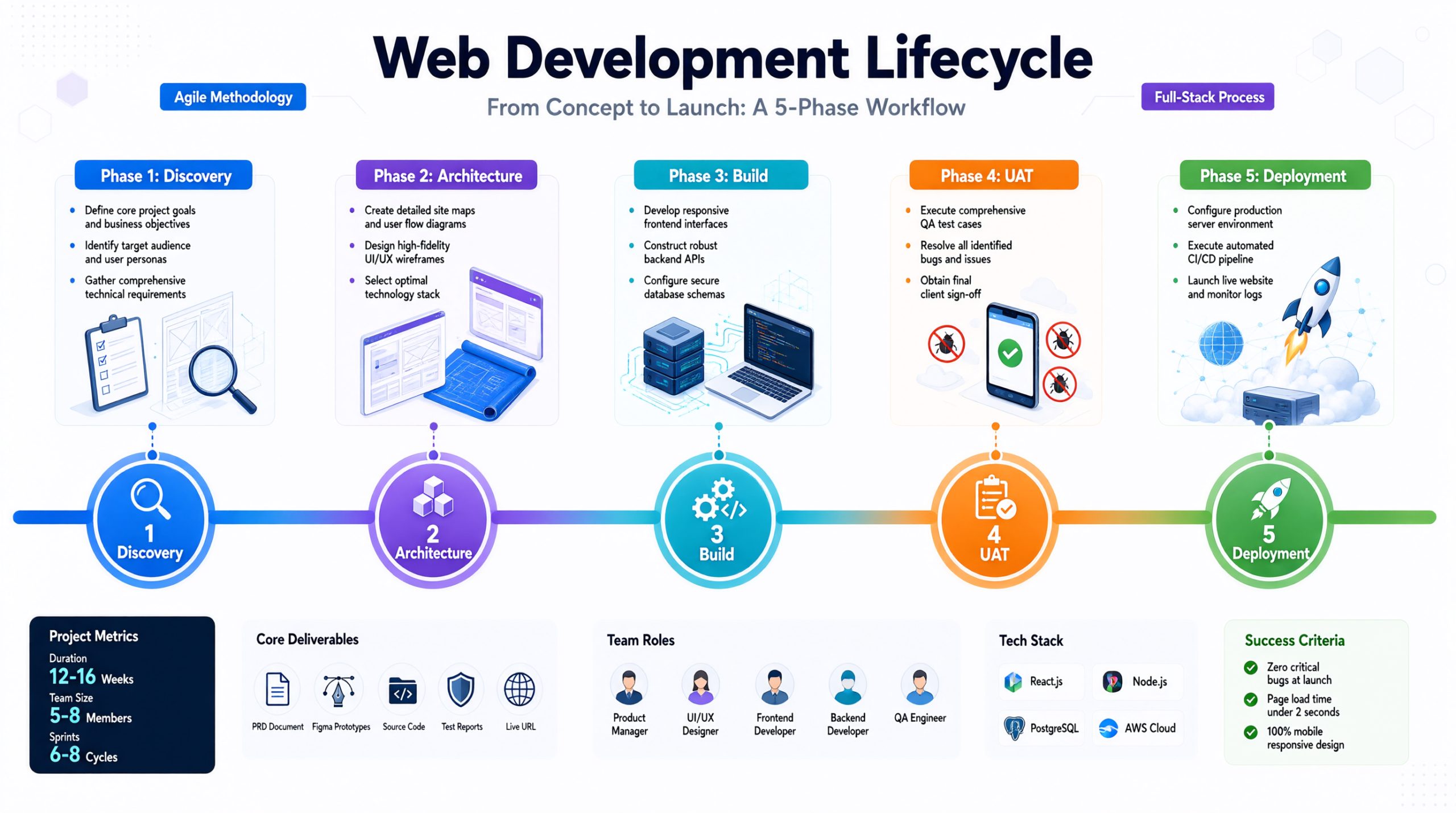
Predictable delivery requires an unambiguous, phased development pipeline that removes scope creep and eliminates technical ambiguity. We structure our delivery into five clear stages designed around speed, operational transparency, and immediate utility.
- Discovery & Structural Scoping: We analyze your primary buyer journey, identify the essential proof points required to validate your offer, and establish the exact placement of conversion touchpoints.
- Architecture & Wireframe Alignment: Our team delivers the responsive single-page visual blueprint and section hierarchy for your review, confirming typography, color systems, and messaging flow.
- High-Performance Implementation: We engineer the page using a lightweight, modern stack (React, Next.js, or streamlined headless configurations), ensuring sub-second load times and mobile-responsive layout integrity.
- User Acceptance Testing (UAT): We execute cross-device rendering audits, verify outbound analytics triggers, validate form endpoints to your designated email or messaging webhooks, and benchmark core page-load metrics.
- Asset Handover & Domain Deployment: We connect your custom domain, point edge routing to platforms like Vercel, hand over clean source files, and transfer administrative access with zero vendor lock-in.
When Is a Single-Page Site the Right Strategic Investment?
A one-page architecture is an intentional engineering choice designed for high-conversion velocity. It solves specific commercial problems but is deliberately constrained against enterprise software workflows.
                      ┌─────────────────────────────────────────┐
                      │    Do you require complex accounts,     │
                      │  e-commerce checkout, or custom ERP?    │
                      └────────────────────┬────────────────────┘
                                           │
                           ┌───────────────┴───────────────┐
                          YES                              NO
                           │                               │
             ┌─────────────▼────────────┐    ┌─────────────▼────────────┐
             │ Custom Web Application / │    │ Is your primary goal     │
             │ Multi-Page System Needed │    │ capturing qualified leads│
             └──────────────────────────┘    │ or validating an offer?  │
                                             └─────────────┬────────────┘
                                                           │
                                            ┌──────────────┴──────────────┐
                                           YES                            NO
                                            │                             │
                              ┌─────────────▼────────────┐  ┌─────────────▼────────────┐
                              │ Deploy Turnkey One-Page  │  │ Re-evaluate Marketing   │
                              │ Website in 3-7 Days      │  │ Channel Strategy First   │
                              └──────────────────────────┘  └──────────────────────────┘
Ideal Operational Scenarios
- Local Service Enterprises: Clinics, boutique design agencies, educational facilities, and specialty contractors that require a clean, authoritative channel to drive consultation bookings and inbound phone calls.
- Early-Stage Startups & Seed Ventures: Founding teams preparing an MVP launch or investor roadshow that need to establish institutional credibility and collect early user waitlists without hiring full-time developers.
- Independent Consultants & B2B Specialists: High-ticket professionals who need to replace basic resumes with an authoritative case narrative, service breakdown, and automated booking integration.
- Dedicated Marketing Campaigns: Established enterprises introducing a focused product line, regional event, or seasonal offering that requires an isolated landing funnel separated from legacy corporate site clutter.
When to Choose Alternative Architecture
A one-page deployment is structurally unsuitable for businesses requiring:
- Multi-tier customer authentication and role-based access control.
- Native e-commerce carts with multi-currency inventory management.
- Dynamic data sorting across hundreds of catalog items or complex relational databases.
- Deep, custom API integrations into proprietary enterprise resource planning (ERP) software.
When your operational requirements call for complex relational data or native transaction processing, treating the initiative as custom web software rather than a marketing landing asset protects your capital.
Red Code Expert Perspective
A recurring challenge for expanding local businesses and emerging tech startups is the risk of “premature structural expansion.” We frequently consult for clients who previously spent tens of millions of dong commissioning massive ten-page corporate websites, only to discover that 92% of their traffic arrived via mobile devices directly onto a single promotion page. Because the legacy agency built the site on an unoptimized, plugin-heavy framework with extensive database queries, the page took over four seconds to load over mobile networks, crippling paid ad conversions.
Our field solution for this scenario is our Selective Component Isolation framework. Instead of rebuilding or untangling an entire legacy website, we deploy a decoupled, lightweight one-page asset on a high-speed subdomain or dedicated campaign domain using Next.js and edge hosting. We wire the conversion forms directly to the client’s existing CRM or instant messaging notification channels via lightweight API endpoints.
This setup achieves sub-second paint times on mobile networks, insulates the client’s marketing campaigns from main-site downtime, and keeps maintenance costs near zero. If your operational objective is simply validating paid traffic or capturing inbound inquiries, do not pay to remodel the entire corporate building when an agile, secure point of entry achieves the exact business outcome.
Frequently Asked Questions
Will a single-page layout provide enough space to showcase all my services?
Yes. By organizing content into prioritized narrative sections—core problem, proprietary methodology, visual proof points, and clear packages—a single page delivers complete commercial clarity. Decision-makers prefer structured, scannable information over navigating complex multi-page menus.
Can our internal team update text and images after project handover?
Yes. Depending on your team’s workflow requirements, we build on modern headless engines or streamlined content management setups. We provide straightforward administrative access during handover, enabling non-technical staff to revise text, update photography, and view form submissions without vendor involvement.
Are domain registration and hosting infrastructure included in the price?
Yes. Our turnkey engagement includes first-year domain configuration and high-performance hosting setup on modern edge networks like Vercel [needs condition confirmation]. After the first year, ongoing maintenance remains minimal because our modern decoupled architecture eliminates costly monthly server maintenance retainers.
Can this single page be expanded into a multi-page website later?
Yes. Because we engineer projects using modular frameworks like React and Next.js, the codebase is fundamentally scalable. As your product catalog, service offerings, or editorial content expand, our team can introduce additional routing and pages on top of your existing foundational assets.
Deploying a high-converting digital storefront does not require months of development overhead or unpredictable agency retainers. By aligning modern engineering standards with focused commercial messaging, our one-page website service delivers a reliable, cost-effective asset that accelerates business growth.
Tell us what you're building.
We reply within one business day.
Start a project